Someone asked if there was a copy of what I said at my mother’s wake. Unfortunately, our recording failed us, but here’s a draft of the text I wrote in advance. I ended up talking it, rather than reading it, so what I actually said will differ a bit from this. But the essence is there.
*****
I’m going to tell you some stories about beef and potato curry, and tell you a little about my mother as I go. Many of you here have enjoyed my mother’s cooking, and if you haven’t, I’m sorry – you really missed out! She and her sisters were all excellent cooks, but you’ll forgive a daughter for thinking her mother was the best of them. We came to the U.S. from Sri Lanka when I was two, and I was lucky enough to grow up eating her rice and curry for dinner every night.
She’d let me cook a little, growing up, but she kept me on onion duty. Chopping onions – three onions for every dish, so one everyday dinner with a meat dish and a vegetable dish would take six onions. That was about all I was allowed to do. For a party, we’d need a lot more onions, of course. For a party with a dozen curries, Daddy would bring home at least three bags of onions, and we’d chop them all. Onion tears were irrelevant.
Amma would come stand over me and watch me chop onions, and say, disappointed, “Chop them smaller. More even.” Have you seen a French cutting board, inscribed with a grid of measurements, so you make sure all your chopped food is uniform in size (uneven pieces mean that some take longer to cook than others)? And the measurements help you cut to the precise ideal increments. A fine brunoise, for example, should be 3mm x 3mm square. Such a small, even dice, I eventually came to learn, meant that the onions would break down faster when sautéing into a smooth sauce.
Eventually, Amma let me graduate to stirring the onions too, sautéing them in vegetable oil with cumin and mustard seed, ginger and garlic and curry leaves. I found it boring and frustrating, being only allowed to chop and sauté mounds of onions – so boring that I would sometimes read a book while stirring. If Amma caught me, I’d get in big trouble, because the onions were much more likely to burn – and by burn, she meant some of them would get a little more brown than they were supposed to be.
Many years later, I was talking with a professional chef, and she told me that the way Amma trained me was exactly the way you’d start in a professional kitchen – days and weeks and months of chopping onions. Amma would have excelled as a fancy French restaurant chef, if she’d only had the chance.
I took her food for granted, as children do, until I went away to college in the Midwest, and discovered just how bland dorm cafeteria food could be. I called Amma up, desperate, because I didn’t know how to cook anything but onions. She told me how to make my favorite dish, beef and potato curry, over the phone. It was the dish she always had waiting for me, when I flew home for college – the taste of comfort and home.
I cooked beef and potato curry over and over again – first for just me, then for all of my friends, neighbors, random strange students who wandered into our suite, drawn by the incredible scent. When I was feeling virtuous, I made it with rice and a vegetable – a carrot or green bean curry. But most of the time, I just ate it straight up out of the pot on slices of thick white bread. On one particularly rough day, over a couple of hours, I ate through an entire loaf of white bread with accompanying curry. My stomach was painfully full, but I regret nothing.
I usually didn’t cook it perfectly – I was still careless, prone to distraction. Once, I set rice cooking, let the water come to a boil, covered it and turned it down to low – and then wandered off to get into an argument with a floormate about Wittgenstein, I think. The next thing we knew, the fire alarms were going off, and the entire six-hundred-person dorm was emptied onto the street. When they let us back into the room, I found our kitchen filled with smoke, and a pot on the stove that looked like it was filled with black rock lava – my poor rice!
That summer, I went home determined to learn how to cook more, and better. I asked Amma to teach me to cook, and she said, “Just watch!” That was how she’d learned – by paying the most careful of attention. I didn’t trust my memory for that; I wanted a written recipe. Amma didn’t need to measure her spices – she just threw in the cumin seed, mustard seed, cinnamon and cloves and cardamom. I ended up standing next to the pot with cupped hands, grabbing the spices as she threw them in, measuring them and writing the amounts down, and then finally adding them to the pot.
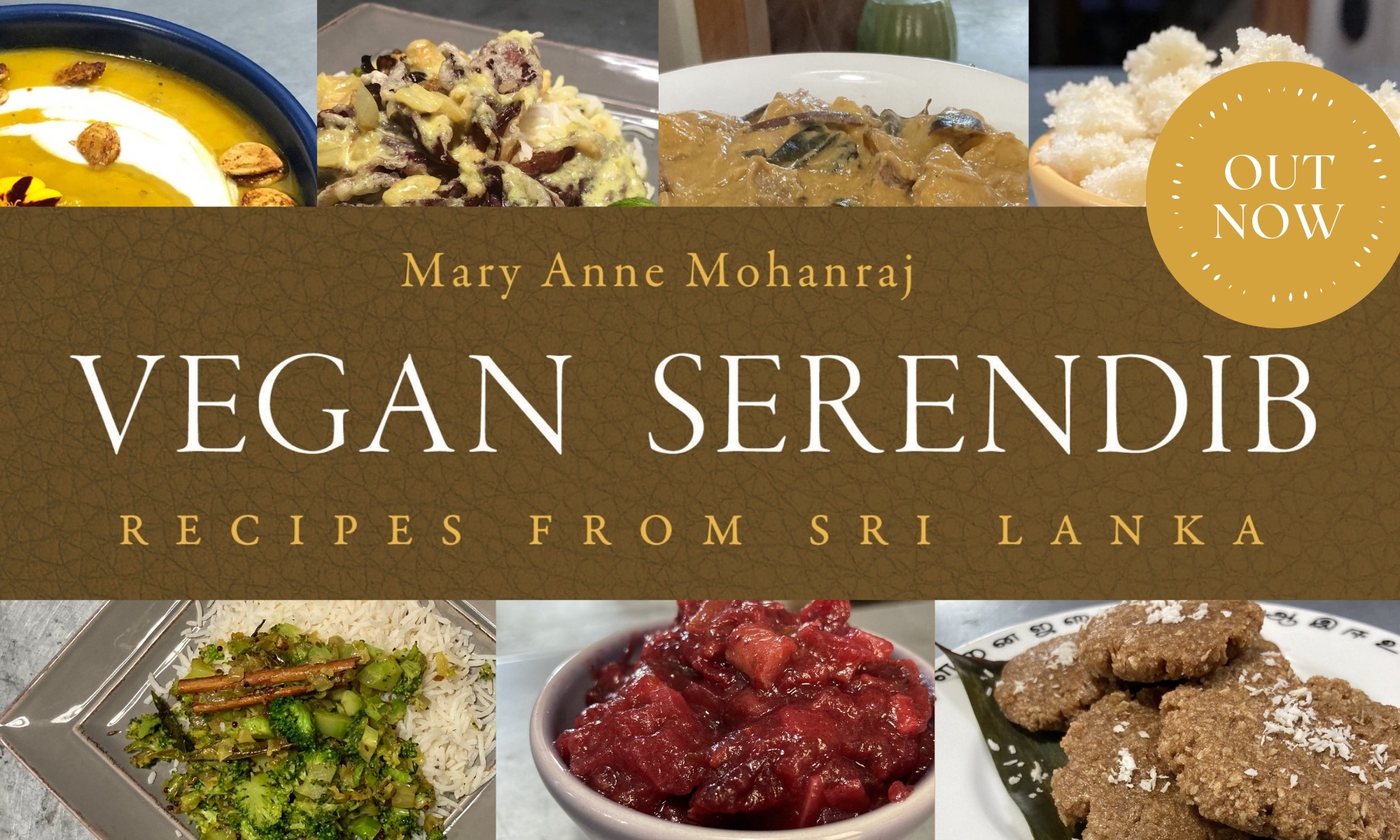
A few Christmases later, I had a friend with a small publishing house who was willing to print something for me – I’d decided to write down Amma’s recipes and give them to her as a small book. That first cookbook was perhaps thirty recipes, and I was so proud when I gave it to her. She opened it, started paging through, and within a few minutes was pointing out my mistakes. “You got that wrong. That one too.” I offered to bring out a second edition with “Amma’s Corrections,” marked in red, but alas, she didn’t go for it.
That was the beginning – I ended up researching and learning many more Sri Lankan recipes. But I didn’t really learn to cook from the recipes. I learned from the practice, from chopping thousands of onions. And even more, I learned from eating her food every night for twenty years – my tongue knows how our food is supposed to taste, at its best.
Also, sitting around with her and my many aunties after one of her massive parties, critiquing the dishes, was an education in itself. The aunties had all brought dishes as well – when you’re feeding two hundred Sri Lankans for your kid’s birthday party, even my mother needed help. We’d have eaten well, be sitting back, replete, perhaps with a pants button discreetly unbuttoned. And then the critique would start – never mean, but constructive. ‘Don’t you think the dal needed a little more salt? ‘No, no, it was fine. But did you forget the lime juice in the eggplant?’ ‘I *used* lime juice…but the bottle was old. I should’ve cut some fresh limes. AND they were out of the Chaokoh coconut milk at the store…’
That’s how the knowledge gets passed down, and the skills refined. That’s where you can see the love made manifest.
Sometime in my 30s, I’d gone out of town for a conference. I came home exhausted, but when I walked in the door of our apartment, I could smell beef and potato curry. It made no sense. I’d been living with Kevin for many years by then, and he’d certainly eaten the dish many times, but I’d never taught him how to make it. But there it was, waiting on the stove for me, with a pot of rice beside it. He’d learned by paying careful attention when I cooked, by doing exactly what Amma had told me to do, “Just watch!” And yes, the final version didn’t taste exactly like hers, but then, most of the time, mine doesn’t either. It’s not easy, matching perfection. The fact that he’d gone to the effort, that was the part that made me want to cry.
Some people hoard their recipes; there’s a long tradition of women keeping them to themselves, or only passing them to their daughters. Recipes were wealth. But Amma never asked me to keep her recipes to myself.
She was always curious, always thinking, always trying to make the dish just a little bit better next time, pouring her time and energy and labor into the work, striving for perfection. And everything she learned, she shared with her community, with all the people she loved, and who loved her. She wanted everyone to succeed, to thrive, to eat well, and to share delicious food in company, with laughter and joy. That’s a legacy I hope to pass on.
*****
In memoriam: Jacintha Alageswary Mohanraj (1951 – 2026)